
A beginner-friendly guide to building your own foam cutting machine
A hotwire foam cutter uses electrical resistance to heat a wire. When electrons flow through a conductive material, they collide with atoms in the wire. These collisions convert electrical energy into heat—a phenomenon called
Different metals conduct electricity differently. Copper and aluminum have low resistance, so electrons pass through too easily without generating much heat. We need a material with higher resistance.
Nickel-Chromium (NiChrome) alloy is ideal because it has enough resistance to glow hot when current passes through, but not so much that it melts instantly. It's the sweet spot for controlled heating.
click here if low voltage bores youYour power supply converts dangerous AC wall power into safer DC power. Look for the silkscreen labels on your unit:
Even though your motor controller probably has a fuse, add an external one between the power supply and controller. This protects your controller from power supply failures.
How to wire it: Cut one of the wires running from V+ on the power supply. Connect one end to the fuse holder, the other end to the remaining terminal. Use a 9A or 10A fuse.
Wire the fused output from your power supply to the motor controller's input terminals (usually marked + and - or IN). The controller's output terminals will connect to your hot wire later.
The motor controller lets you adjust voltage, which controls wire temperature. More voltage = hotter wire = faster cuts but more risk of melting too deep.
Cut your 18 gauge wire into manageable lengths. Strip about 2cm (3/4 inch) from each end.
Important: Don't burn the insulation off with a lighter. It leaves carbon residue that creates poor connections and smells terrible. Use proper wire strippers or carefully score and peel the insulation.
Take your lamp cord (unplugged!) and strip the ends. Your power supply has three AC terminals:
Connect Live and Neutral to the AC In terminals. Match the colors if your power supply indicates L and N.
Here's where you decide how "radical" you want to be. The ground wire protects you if something fails internally and touches the metal case.
Option A (Safe): Connect the ground wire to the ground terminal. If your house has old wiring, definitely do this.
Option B (Living dangerously): Skip it and hope for the best. Not recommended, but acknowledged as a choice some people make.
Connect your 18 gauge wires from the motor controller output to the 26 gauge NiChrome wire . Polarity doesn't matter here—it's just heating a resistor.
The wire should be taut but not stretched to breaking.
Before plugging in:
Plug it in, turn on your lamp switch, and slowly turn up the motor controller. The wire should start to glow dull red. If it glows bright orange immediately, turn it down—that's too hot and will melt through your foam too aggressively.
The frame is stupid easy to build. You need a base, a vertical post, and a horizontal arm, be aware of the tension that the arm has to withstand! be sure to aknowlage how i built it as i think it is most optimal for the arm not bending or breaking. That's it. Three pieces of wood, some screws, and the determination of someone who doesn't want to spend 50 bucks on a "professional" frame.
Materials I used:
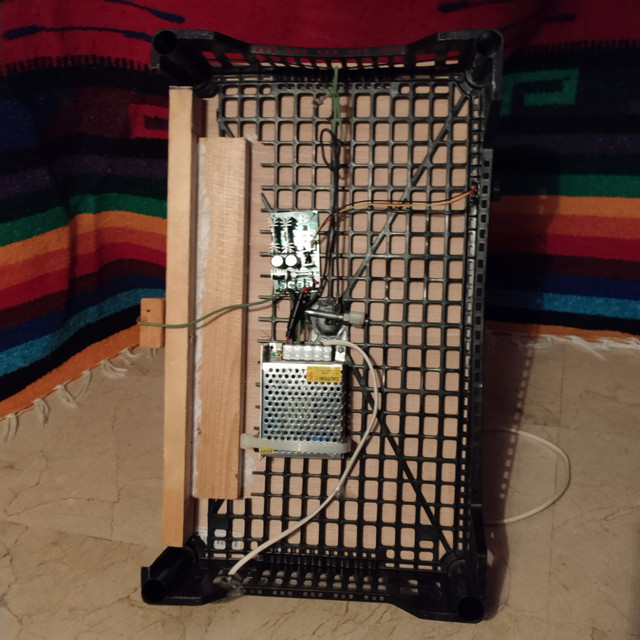
The fruit box becomes your base. It's heavy enough not to tip over, has a flat bottom, and best of all—it was free. Cut a slot in the top for your vertical post. Drill some holes, slap some silicone in there if you're feeling professional, and screw that post down tight.
For the horizontal arm, just screw another piece of wood to the top of your post. Make it stick out far enough that you can mount your bolts for the NiChrome wire. I drilled holes through the end of mine and stuck bolts through with washers and butterfly nuts so I can adjust tension.
Is it pretty? No. Does it work? Absolutely. And when your friends ask where you bought it, you get to say "I built it from trash" which is infinitely cooler.
Pro tip: If your wood splits when you screw into it, you're either using the wrong screws or you have the grip strength of a hydraulic press. Pre-drill your holes, people. It's not cheating, it's physics.


Cat photo
 click the picture above!!!!
Once working, you can cut:

Guide by Alex | Built with questionable decisions and working electronics
Disclaimer: Electricity is dangerous if youre dumb. Build at your own risk. If you die, it's not my fault.